
Loading...
Serving Fayetteville, AR and surrounding areas. (479) 485-4688
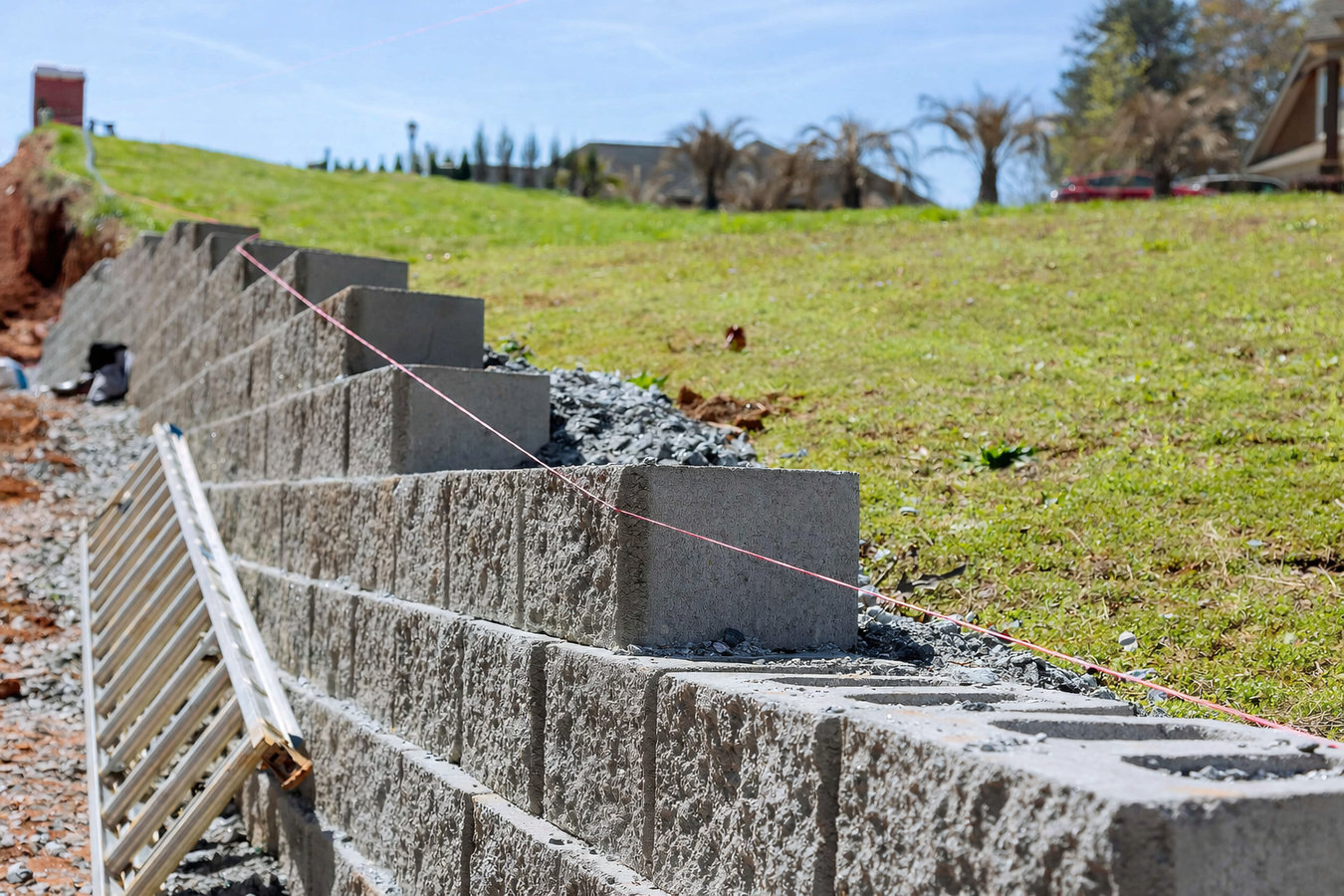
Most retaining walls in Fayetteville fail because of poor drainage, not weak materials. We build walls that handle hydrostatic pressure, clay soil movement, and spring rain - so they look the same in year ten as they do on day one.
Retaining wall construction in Fayetteville, AR holds back a slope or grade change - turning unusable hillside into flat usable space, protecting a driveway edge from sliding soil, or keeping a planting bed from washing out in heavy spring rain. Most residential retaining walls here are 2 to 6 feet tall.
The Fayetteville area's clay-heavy soil and wet springs make drainage the most critical part of any retaining wall project. Without a gravel backfill column and a perforated drain pipe behind the wall, hydrostatic pressure builds after every rain - the force that pushes walls forward and causes them to bow or tip within a few years. Addressing drainage correctly at the start is what separates a wall that holds for decades from one that fails.
Retaining wall projects are frequently combined with concrete block wall construction when the site also needs a structural boundary or foundation element, or with masonry restoration when an aging wall needs repair and stabilization rather than full replacement.
A wall that has developed a visible lean or bow is under hydrostatic pressure from water-saturated soil behind it. In Fayetteville's wet springs, this happens faster than most homeowners expect when drainage was not properly installed at construction. Once a wall starts to move it rarely self-corrects - catching it early avoids a complete rebuild.
Hairline cracks in mortar joints are cosmetic. Cracks that run through block or stone units, or that appear at corners and step-downs, indicate structural movement - often caused by freeze-thaw cycling on a shallow footing or by shifting clay soil underneath. These cracks tend to widen each season if nothing is done.
If soil behind the wall spills over the top or washes around the ends after heavy rain, the wall is no longer effectively retaining the grade. This is common in Fayetteville when the original wall was built without adequate drainage and the retained soil has saturated and started to migrate. What starts as a minor nuisance becomes a larger slope failure if not addressed.
Slopes without a wall that lose soil or mulch every spring are telling you the grade exceeds what ground cover or roots can hold. Left alone, erosion gradually undercuts anything built at the top of the slope - driveway edges, fences, or planted areas. Building a properly designed retaining wall converts that eroding slope into stable, usable space.
Regardless of the material you choose, every wall we build includes excavation of a proper compacted footing base, gravel backfill behind the wall face, and a perforated drain pipe at the base of the wall to redirect hydrostatic pressure away from the structure. Skipping any of these steps is the most common reason walls fail in Northwest Arkansas - we do not skip them.
Walls over 4 feet that require a City of Fayetteville building permit are handled as part of our project scope - we research the requirement during the estimate visit and manage the paperwork before any excavation begins. The City of Fayetteville Development Services administers these permits.
The most common choice for residential retaining walls in Fayetteville - interlocking block systems like Allan Block and Versa-Lok handle this climate well, come in a range of textures and colors, and work at most residential heights. Cost-effective, durable, and widely proven in Northwest Arkansas conditions.
Fieldstone, limestone, and other natural stone options blend naturally with Ozark-area landscapes. Dry-stack walls have an informal, traditional look that suits older Fayetteville neighborhoods. Higher material and labor cost than block, but the finished appearance is distinctive and ages well.
Lower initial cost than block or stone. Timber walls work well for lower decorative walls around planting beds and informal garden areas. In Northwest Arkansas's wet seasons, timber walls have a realistic lifespan of 15 to 20 years - a reasonable choice for the right application and budget.
Taller slopes often perform better as two or three shorter walls separated by a planting terrace than as a single tall wall. This spreads the load, reduces hydrostatic pressure on any one structure, and creates more usable yard space between levels. We design terraced systems when the site grade and soil conditions call for it.
Fayetteville sits on rolling terrain carved by streams draining toward the Illinois River watershed - most residential lots here have at least one meaningful grade change, and many have slopes steep enough to require a retaining wall to make the yard usable. That rolling topography is part of what makes Northwest Arkansas attractive, but it creates real engineering demands for anything meant to hold back a slope.
The two forces that most often destroy retaining walls here are clay soil and water. Clay soil is expansive - it swells when saturated and contracts when dry, and it holds water longer than sandy or loamy soil. That retained moisture becomes hydrostatic pressure against any wall face during Fayetteville's wet springs. The University of Arkansas Cooperative Extension documents clay soil distribution across Washington County. Combined with freeze-thaw cycling in winter, a wall built without proper drainage and a deep compacted footing faces significant forces from both directions.
We serve homeowners throughout the greater Fayetteville area including Springdale and Rogers, where newer subdivision development has graded many lots in ways that create short, steep slopes between homes and along property lines - exactly the kind of situation where a properly built retaining wall prevents ongoing erosion problems.
We walk the slope with you, assess soil conditions and drainage, confirm wall height and length, and check whether a City of Fayetteville building permit is required. You receive a written, itemized estimate before we leave - no verbal ballparks.
For walls requiring a permit, we handle the application and inspection scheduling before breaking ground. We coordinate the start date around soil moisture conditions when possible - saturated clay slopes require additional care during excavation.
The base trench is excavated, compacted, and leveled. Crushed stone base is set at the proper depth for this soil type. A perforated drain pipe is installed at the base of the wall and routed to daylight - this is the step that determines how long your wall lasts.
Courses are set level and plumb, with geogrid deadman layers for taller walls where required. Gravel backfill is placed and compacted in lifts behind the wall face. The top of the wall is capped, the site is graded and cleaned, and we walk the finished project with you.
Free written estimate, no obligation. We check permit requirements for your specific site before any work begins.
(479) 485-4688We do not build retaining walls without proper drainage backfill and a perforated drain pipe - period. Skipping this step is the most common reason walls fail in Fayetteville's wet climate. Any contractor offering a significantly lower price may be leaving drainage out of the scope. Ask specifically what drainage system they include before accepting an estimate.
Fayetteville requires permits for walls above certain heights, and walls built without required permits can create complications when you sell the property. We determine what is required for your specific wall during the estimate visit and manage the permit process before work starts.
You receive a written estimate detailing labor, materials, drainage components, and any permit fees before we ask for a signature. No verbal approximations, no scope that expands once work has started. Understanding exactly what you are paying for before the project begins protects you throughout the project.
We hold an Arkansas contractor's license through the Arkansas Contractors Licensing Board and carry general liability insurance. For a project that involves excavation near your home's foundation or a neighbor's property, verifying contractor credentials before work begins is a straightforward step worth taking.
Structural concrete block construction for boundary walls, garden walls, and foundation elements that require load-bearing capacity beyond a standard retaining wall.
Learn MoreRepair and stabilization for aging retaining walls and masonry structures where replacement is not needed but deteriorating mortar and cracked sections require professional attention.
Learn MoreSpring booking windows fill quickly. Reach out now and we will walk your site, check permit requirements, and give you a written estimate with no obligation.